Navigation Menu

April

Better Than We Ever Could Have Imagined
Welcome To Pearlle Magazine. Africa, K-Pop, And Everything In Between.
Showing posts with label environment. Show all posts

Apathy and social movements in the Niger Delta

Hey folks,

I've been away for a minute, still finishing up my summer semester. Here's a paper I wrote for my social movements class. It's about the Niger Delta, and I'm posting only an introduction and the rest of the paper links to Google Docs. The rest of the paper can be viewed here


Oil was discovered in 1956, in Oloibiri, Bayelsa State, in Nigeria’s Niger Delta region. The 2006 population census indicates that about 30 million of Nigeria’s population of 140 million citizens lives in the region (National Population Commission, Nigeria). Since the 1970’s, oil revenue has been the backbone of the economy, accounting for about 65 percent of budgetary revenue (OPEC), which is largely derived from nine Niger Delta states. The largest ethnic groups in the region include the Ijaw, Ogoni, Efik, Isoko, and Urhobo, to name a few. Economic marginalization of indigenes is the main basis for agitation in the region. Oil revenue has done very little for development, but pollution and environmental degradation is rife. The Niger Delta crisis has been described as the greatest challenge facing the Nigerian state since the onset of democratic rule in May 1999. The crisis has led to the emergence of numerous protest movements, such as the Movement for the Survival of Ogoni People (MOSOP), Movement for the Emancipation of the Niger Delta (MEND), Ijaw Council for Human Rights (ICHR), Ijaw Youth Council (IYC), the Niger Delta Focus (NDF), and the Women Initiatives Network (WINET). I argue that these protest movements have not been successful due to apathy that is the result of class relations, ethnicism, violent state repression, and alienation.

Paper proposal on apathy in the Niger Delta


Below is a paper proposal I submitted for my social movements class. I had a hard time writing this because I was so conflicted. I have never lived in the Niger Delta and I probably do not have the best understanding of the situation. I got feedback from friends and family. My cousin who works with Shell has a different opinion on the cause of "apathy" in the region. I'm also very conflicted on the use of "apathy". In the words of a friend, what looks like non-participation can be a form of resistance. I love having pictures in posts, and while searching for images, I stumbled on this post with multiple images of the Niger Delta on Nairaland.

Taylor and van Dyke define protests as "sites of contestation in which bodies, symbols, identities, practices, and discourses are used to pursue or prevent changes in institutionalized power relations (2004: 268). The current conflict in the Niger Delta is as a result of tensions between foreign oil corporations and ethnic groups in the region over the adverse effects it has brought to the people in the region and the implications on the environment. The Niger Delta crisis has led to the emergence of numerous protest movements, such as the Movement for the Survival of Ogoni People (MOSOP, Ijaw Council for Human Rights (ICHR), the Niger Delta Focus (NDF), and the Women Initiatives Network (WINET). I argue that these protest movements have failed to take off due to apathy among Nigerians.
Protests have been used as a tool to influence decision making in the Niger Delta. Although some of these groups have transitioned from protest groups to militant action, my paper will show that these groups had a core protest agenda at their formation. I will touch on the struggle of these movements to mobilize the media and powerful actors in the Nigerian state as explained by Della Porta and Diani. The success of these protest movements are important to the Niger Delta because of their ability to influence state legislative policy making, which in turn can target the practices of oil companies in the Niger Delta.  

My paper will argue that Nigerians have become apathetic to various Niger Delta movements due to the nature of class relations, ethnicism, alienation of supporters by various movements and state repression. My paper uses the term apathy based on the definition by Bignall (2010, 8) as "socially indicated by a systemic loss of interest and attachment". Ethnic identities are weapons for contesting political power and hence access to oil wealth (Ojakorotu) in a plural society like Nigeria. An example is the Ijaw-Itsekiri (dates) conflict which was oil-induced (Okolo). The violent techniques some of these protest groups have engaged in have alienated supporters. MEND, for example, uses tactics such as guerilla warfare, kidnappings, and pipeline bombings. Della Porta & Diani state that the use of violence has both symbolic and instrumental aims. Violence can be used as a symbolic refusal of an oppressive system and can be used to win specific battles, such as media attention. They also identify some limitation of the logic of violence, such as the possibility of alienating sympathizers (174).  State repression techniques in the Niger Delta usually include military action by the state-led Joint Task Force and  the "destruction of communities by state security forces abound: in Umuechem 1990 and 1993, in Uwheru in 2004 and Odioma in 2005" (Ojakorotu, 2009). This raises important questions for human security especially in a region where poverty, disease, famine, and unemployment is rife.  

Image source
Colonial rule had a divisive impact on intergroup relations in Nigeria. The British artificially divided Nigeria into Districts, Divisions and Provinces which pitted groups against each other (Aghalino, 3). He further notes that "the history of the struggle for autonomy and property rights dates back to the pre-colonial period" and so has the politicization of the common wealth derived from the exploitation of oil. I will analyze oil exploration in the Niger Delta using a trans capitalist lens. In addition, how does the ideology of global capitalism help explain the power struggles over oil profits (whose wealth is not shared by all) and what roles does discrimination based on ethnicity and fascist policies play in these struggles? Can trans capitalism help with resource control or common wealth?

My paper will also touch on the Marxian approach to political economy and class struggles. Using the Marxian perspective that the most important human concern is that of economic struggle, I use this logic to argue the point that this drives apathy in the Niger Delta. The Marxian view point that the only way man can act freely and express himself and his potential is in a "classless society where the interest of all is entrenched and enforced by the rule of the proletariats and power-free social relations"(Omoyibo, 21) results in indifference. Niger Deltans are indifferent to various protest movements happening in the region due to class consciousness and their interactions with the bourgeoisie.
https://mail.google.com/mail/u/0/images/cleardot.gif

Reading reflections on the Divest fossil fuels campaign


Here's part 2 of my reading reflections for my Social Movements class. This week, I focused on the Divest Campaign since the assigned readings were about the environment. Here's part 1 in case you missed it:

Texts:

Bantjes, Rod. Social Movements in a Global Context: Canadian Perspectives. Toronto: Canadian Scholars', 2007. Print.

Della, Porta Donatella, and Mario Diani. Social Movements: An Introduction. Malden, MA: Blackwell Pub., 2006. Print.

The Divest Campaign, launched by GoFossilFree.org encourages institutions to divest from fossil fuel companies. Fossil fuels are the greatest contributors to global warming and the campaign hopes that institutions can properly address climate change by withdrawing economic support of a socially irresponsible industry, pushing climate change higher on the national political agenda. In my reading reflection, the Divest UVic campaign came to mind, especially because of its efforts to get UVic to divest its endowment funds from fossil fuel extraction, transportation, and refining companies. The UVic endowment fund is invested in energy corporations like Enbridge Inc, Encana, Nexen Inc, and Suncor Energy (University of Victoria Combination Pension Plan, 2011 Annual Report).

A little over a year ago, Suncor Energy was charged with spilling more than 26,000 litres of drilling mud into the Atlantic Ocean from an oil platform off Newfoundland and Labrador in 2011 (Financial Post 2012). Bantjes makes reference to firms who try to camouflage their environmentally destructive practices with misleading advertising (258). This is seen in the controversial ad in 2010, where Suncor compares tailings to yogurt. The ad which employed tactics known as green washing was criticized for downplaying the toxicity of tailings.  

Transnational networks are critical to a campaign’s success. Della Porta & Diani also provide insight necessary for looking at campaigns such as Divest using a transnational lens. They explain the emergence of new networks of relationships of trust among movement actors, operating within complex social environments (94). The rampant use of technology among university students makes it easier for communication and coordination to take place between Divest activists in the Global North and South. Supporters of the Divest campaign organize under a collective purpose which prompts them to act collectively, irrespective of geographical location. The campaign is active in over 300 campuses in the USA, Canada, Australia, the UK, India, New Zealand, Bangladesh, and the Netherlands. However, not a single school with an endowment exceeding $1 billion has agreed to divest. Harvard recently hired a VP Sustainability in response to the campaign, although it has refused to divest its $30.7 billion endowment fund (the largest university endowment in the US).

Della Porta & Diani explain that informal communication networks, interaction and mutual support are an essential replacement for the scarcity of organizational resources. Being identified as part of a movement “means being able to count on help and solidarity from activists” (94). UVic’s Divest campaign, which is very similar to other Divest campaigns in higher education institutions in North America, uses informal communication networks such as text messaging, blogs, and Facebook to mobilize. In addition, UVic’s divest campaign works with limited financial resources, and as such, the solidarity of supporters and fellow activists is crucial.  

College campuses have been fertile ground for widespread social and political change. The Divest campaign has been called the biggest student movement in the US in years, unfortunately this is not the case in Canada. Divest campaigns in Canada lack the perception of authority and legitimacy seen in its American counterparts. As a result, it is unable to influence target actors and spark widespread change. To date, no Canadian university has agreed to divest.

Reminiscing Mondays: Nigeria | Neocolonialism and the Ogoni struggle

Today's Reminiscing post looks at neocolonialism in Nigeria and how it's affected the Ogoni people in Nigeria.

Wikipedia defines neo-colonialism as such:

Neo-colonialism (also Neocolonialism) is the geopolitical practice of using capitalism, business globalization, and cultural imperialism to control a country, in lieu of either direct military control or indirect political control, i.e. imperialism and hegemony. The term neo-colonialism was coined by the Ghanaian politician Kwame Nkrumah, to describe the socio-economic and political control that can be exercised economically, linguistically, and culturally, whereby promotion of the culture of the neo-colonist country facilitates the cultural assimilation of the colonised people and thus opens the national economy to the multinational corporations of the neo-colonial country.


The rhetoric we hear in primary/secondary school is, "Nigeria got her independence from the British in 1960 and became an independent country since then". Well, we're still bitches...just independent ones. Colonial rule is over but is transformed into neo-colonialism which still retains and maintains, in this case, economic and commercial ties. Unfortunately, in Nigeria this surface change in power is taken as actual history and the neo-colonial bit is almost ignored.  

The Niger Delta has amazing agricultural land and a lot of resources. The Ogoni people are a huge ethnic group that has lived there for centuries. Thanks to Shell and other companies, the livelihood of people who live in the Niger Delta is permanently threatened. Shell began drilling for oil in 1958 and in 1990 Ken Saro-Wiwa formed the Movement of the Survival of Ogoni People (MOSOP), demanding environmental justice on their land. He was assassinated on November 10 1995 but the struggle continues. 

In typical exploitative fashion, Shell has ignored the well-being of the Ogoni people and other tribes living in the Niger Delta and this is of course being done with the support (direct or indirect) of the Nigerian government. In case you didn't know, crude oil accounts for about 80% of government income. The government doesn't just support Shell but also ensures that peaceful demonstrations don't take place.

Here's some of the crap that's going down:


Whenever we visited our family in Port Harcourt, we didn't really notice the effects of environmental degradation on the land. To be honest, we had nothing to really compare it to. The only thing we constantly heard was how the price of sea food was becoming really expensive because fishermen were finding it harder to catch fish. As kids, it didn't occur to us why this was the case.

We end this with the words of Ken Saro-Wiwa:

'We either win this war to save our land, or we will be exterminated, because we have nowhere to run to.'  

Botswana: Bush men vs Pres. Ian Khama

In a move to protect the country's natural heritage and the tourism agency, Botswana's President Ian Khama announced that starting in 2014, no hunting licenses will be issued. Khama said this decision came as a result of increased poaching in the country which has affected the tourism industry. 

Image source
Keep in mind that the tourism industry contributes to about 12% of Botswana's GDP. Here are some of the arguments I've been reading:

Argument 1
What happens to the communities who benefit immensely from hunting?

Counter argument
 Come on now, instead of killing animals, don't they have more to benefit from the tourism industry? Tourism generates more revenue and more jobs than killing an elephant does.

Counter-counter argument
The tourism industry is reserved for the wealthy. The common man (Thabo) who relies on hunting to make animal skin goods, for example will be out of work.

Counter-counter-counter argument
Can't the Botswana government create more tourism related jobs for Thabo? So he doesn't solely rely on selling his animals skin goods?

Argument 2
Expect poaching to skyrocket 

Counter argument
Can't think of any right now

The Basarwa plan to confront the government on the issue as they see it as a move to undermine and further impoverish them. 

Bottom line: Controversial but welcome news, and leave the animals alone.

Celebrating Namibia's sand dunes (Sossusvlei)

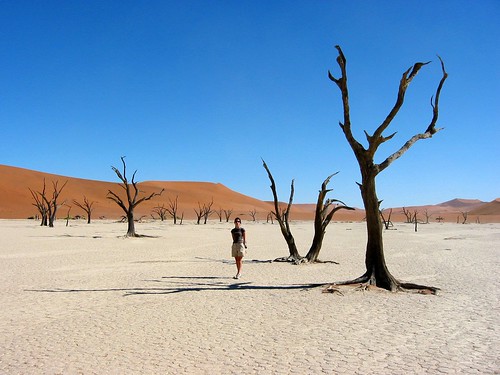
The Sossusvlei pan is a salt and clay pan surrounded by high red dunes, located in the Southern part of the Namib Desert. The name "Sossusvlei" roughly means "dead-end marsh".

Sossusvlei

The Sossusvlei is made up of rich animal life that can survive with little water.

Sesriem gate
This is the main access point to the Namib-Naukluft National Park to visit the sand dunes. The Sesriem is also filled with basic services such as public phones and kiosks for travellers to get general supplies before heading to the dunes.
Sesriem
Image source


The sossusvlei is about 66km past the Sesreim gate, with the last 6km only accessible by four-wheel drive vehicles. It is one of the most photographed places in Sub-Saharan Africa.

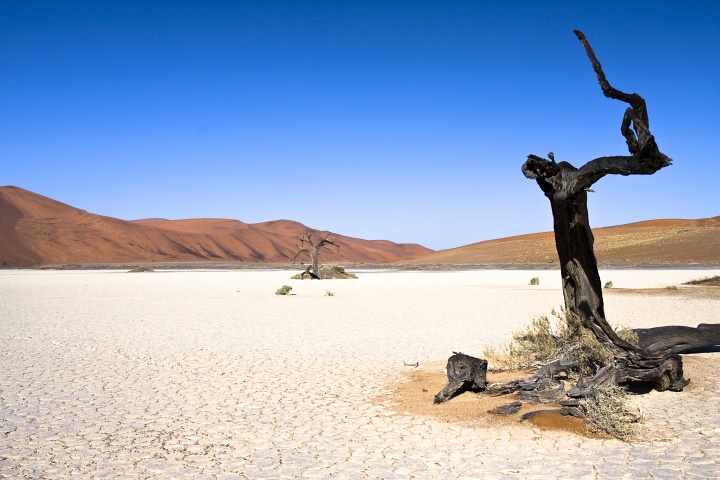
Deadvlei
A clay pan about 2km from Sossusvlei

deadvlei
Image source
 A few things to remember when visiting:
-Carry enough water
-If you're staying at sesriem, you probably should head out about an hour before sunrise to avoid the midday heat
-Wear good quality hiking or trail boots
-Remember that you have to be relatively fit to take the hike up the trails to the Hidden vlei or Deadvlei

hidden vlei
Image source


FDoc Day 4: The Miracle Water Village

It's Day 4 of Five Days of Care and today I want to share what people across the world are doing about cimate change in their communities.

Video 1: The Miracle Water Village 


This video narrates the inspirational story of impoverished farming community in India that reversed its fortunes through its visionary model of water management.

2. Climate Wars Episode 1


Check out episodes 2 and 3

Tomorrow, as we conclude Five Days of Care we'll share a few more inspiring videos guaranteed to make you want to act now!!

FDoC Day 3: Reducing your carbon foot print

Yesterday, we explored the link between climate change, flooding and droughts. We explained that one of the the ways to prevent adverse weather conditions is by reducing our carbon footprint.

A carbon footprint is a measure of the impact human activities leave on the environment in terms of the amount of green house gases produced. Our society has become more carbon dependent and this has led to a rapid increase in the atmospheric concentration of carbon dioxide which leads to global warming, which may result in more severe weather conditions and damage many natural ecosystems.
Image source
Here are some ways we can reduce our carbon footprint:

1. Don't buy bottled water if your tap water is safe to drink

2. Buy fruit that is in season locally.

3. Use household cleaners. You're probably thinking "say whaat?". Using products such as vinegar and baking soda work just as well to clean the bathroom and kitchen. Sprinkle vinegar, followed by baking soda on your bathtub/toilet bowl to get rid of dirt and grime.

4. Turn down your central heating and use the aluminum foil method to still keep your house warm.

5. Fill your dishwasher and washing machine with a full load. This will save you water and electricity.

6. Carpool to work or when taking the kids to school.

7. Think twice about printing documents at work.

8. Fix leaking taps immediately.

9. Use the bus/train instead of using your car.

FDoC Day 2: The link between climate change, floods and droughts

It's Day 2 of Five Days of Care!! Yesterday, we shared easy ways that you can show love to our environment. Today, we'll explore the link between climate change, floods and droughts.

 Floods and droughts are among the most dangerous and costly of all natural disasters. The United Nations estimates that during 1970-2005 over 30% of natural disasters were floods and nearly 15% were droughts or drought-related (wild fires and extreme high temperatures).

Droughts are the also the  main cause of agricultural distress due to damage of food crops and less food production. Droughts also lead to loss of wildlife, diseases, desertification, unemployment and wild fires. Floods on the other hand destroy drainage systems of cities, damage property and cause infectious diseases.
june lagos flood
June 2012 Lagos, Nigeria floods
Image source
Climate change and floods
A rise in sea level and severe rain are two causes of floods. Long term changes in the hydrological cycle (the flow of water throughout Earth) due to higher temperatures (more evaporation; melting of ice, more intense rain fall) contribute to more floods. More water vapor in the atmosphere, because the atmosphere is heating up can lead to more regular floods.

A rise in sea level will also contribute to more floods. The sea level rises when water warms up and increases in amount, or when glaciers and ice melt. When glaciers and ice melt, the sea level increases and floods could happen more frequently and last longer.

Climate change and droughts
Global warming and climate change will also result in more droughts. Changes in the hydrological cycle causes a change in precipitation, meaning some places will get more water and others will become drier. A build up of water vapor in the atmosphere due to the environment heating up, or sudden changes in climate causes droughts to happen more frequently.

One of the ways we can help the environment is by reducing our carbon foot print. In tomorrow's post, I'll be explaining how to do this.

Five Days of Care: Easy ways to make a difference

Yesterday, we started Five Days of Care and today, we kick of Day 1 of FDoC with this post about easy things you can do to show the planet that you care. Caring for the environment does not have to be a daunting life change. Little things do count as well.

1. Plant a tree

2. Refuse: Part of the 5 R's (Reduce, Reuse, Recycle, Rethink and Refuse) which essentially means saying no to using products that are harmful to the environment. Here in Canada, an easy one is plastic bags. I have since refused to use plastic bags, and always go with my own shopping bags. This really helps with waste management.
3. Use compact fluorescent light bulbs.

4. Turn off computers at night

5. Don't preheat the oven unless when baking pastries or bread.

6. Air dry your clothes\

7. Controversial, but use washable diapers and air dry them.

8. Use one less paper napkin whenever you eat out.

9. Say no to bottled water.

10. Buy second hand items

11. Buy more local products

12. Run errands in batches: Make a list of your errands for the day, and try doing them in one trip. This saves you gas and time.

13. Turn off lights

14. Properly maintain your vehicle as clean air filters and properly inflated tires can greatly improve your vehicle's performance.

15. Use matches over lighters, as most lighters are made up of plastic and filled with petroleum products.

16. Consider giving away an item before throwing it away

17. Save water by going to a car wash

18. Avoid extra packaging by downloading your software

19. Use e-tickets as opposed to paper tickets.

20. Pay bills online

21. Stop paper bank statements

22. Use rechargeable batteries.


Take the challenge: Five Days of Care (FDoC)

This week on Pearlle, we challenge you to be kind to your environment because climate change is real and it`s among us. That is the inspiration for this challenge and we hope you join us on this journey.

We may try to ignore the effects of climate change and act like it does not affect us, but we need to own up to the fact that climate changes poses a threat to development and poverty reduction in developing countries. Extreme weather affects agricultural productivity and can raise the price of staple foods, such as grains, that are important to poor households. 


Image source

We`re not going to wait for our government to tackle this issue although they should. We`re taking matters into our own hands. Many times when people think of climate change, they think of inconvenience, costs,  lack of care, etc. In poorer countries, when a family has to think of food and shelter, it is understandable that climate change is not on top of the priorities list. Most people don`t exactly have the luxuries to go out and buy a recycle bin and take it to a nearest recycling station which is probably non-existent. However, we encourage you to make inexpensive changes in your daily like in order to save the environment.  

The weather affects main economic activities in developing countries, such as farming. Global warming dries out farmland, leaving Africa`s desert or arid regions severely exposed. One study predicts that by 2080 as much as a fifth of Africa’s farmland will be severely stressed. Global warming is also speeding up the earth’s hydrologic cycle, causing both floods and droughts (more rains fall in shorter periods, with longer gaps between). Think of the flood that happened a little over two weeks ago in Lagos, Nigeria.


In the next FDoC post, I`ll share easy ways you can show that you care about the environment.

Celebrating Botswana’s Okavango Delta

The Okavango Delta in Botswana is is a large inland delta and one of the last totally unspoiled Wildlife areas in Africa. The Okavango takes its name from the Kavango people of Northern Namibia. David Livingstone is the first known European to have seen the Okavango in 1849. 
Image Source

Wildlife

The Okavango Delta is a popular tourist destination. Species of animals that can be found in the Okavango Delta include African Bush Elephant, African Buffalo, Hippopotamus, Giraffe, Brown Hyena, Cheetah, Leopard, Lion and much more. The endangered African Wild Dog remarkably still survives in the Okavango Delta


The Okavango Delta also includes over 400 species of birds and 70 fish species.

People
5 ethnic groups of people make up the Okavango Delta, each with its own ethnic identity and language. The Okavango Delta is under the political control of the Batawana.

Accommodation

Accommodation can range from luxury suites to basic tents. A trip to the Okavango Delta can be quite expensive but before you scream in despair at the cost, know that it is deliberate. The government of Botswana uses this as a way to limit the number of tourists in a bid to lessen the environmental impact.


Sanctuary Baines' Camp

Here are some places to check out:

Mankwe Bush Lodge

Moremi Game Reserve

Sanctuary Stanley’s Camp

Tubu Tree Camp

Selinda Camp

Oddball’s Camp

Xigera Camp

Mocatoo Horseback Safari Camp


Get more information on Trip Advisor